
MENOIA
App Design
Product Design, UX/UI, Information Architecture, Trend Visualization, Community-Led Care, Visual System
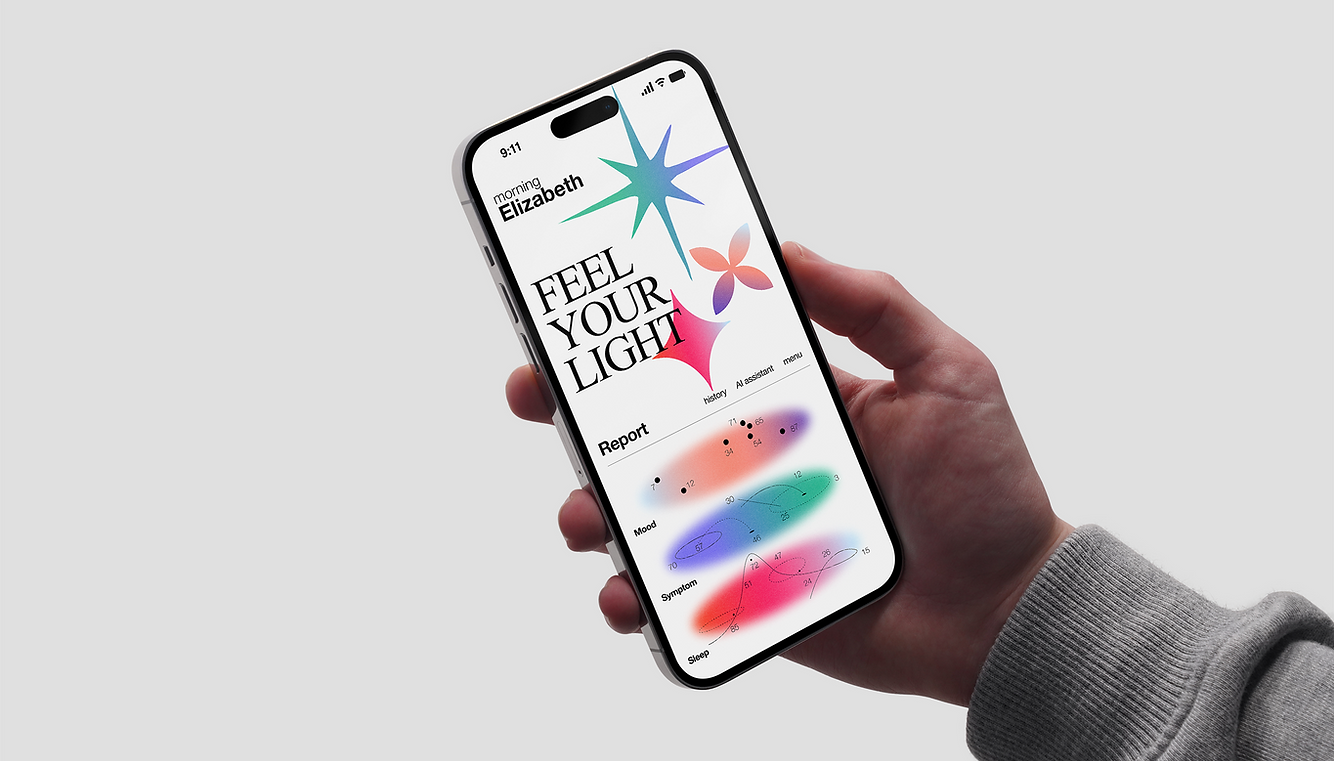
Created a menopause support app designed for long-term self-reported wellbeing tracking, integrating low-burden logging, trend-based visualization, and community-led support to make recurring and hard-to-articulate experiences more legible in daily life. Guided the full product workflow from observation and research through IA planning, interaction flow design, and prototyping in Figma, with supporting visual system development in Illustrator, building a sustainable support system that prioritizes companionship and clarity while maintaining clear boundaries from medical diagnosis or treatment.
Built from repeated everyday experiences of miscommunication and emotional conflict, this project reframes menopause not as a private “phase,” but as a long-term condition that often lacks language, structure, and support.
The project’s objective was to design MENOIA as a sustainable digital support system for long-term self-reported wellbeing tracking. It helps users build self-awareness through low-burden daily logging, reviewable trend visualization, and community-led care, while maintaining clear boundaries from diagnosis or treatment.

Through observation and research, I found that many women experience recurring emotional and physical discomfort that is difficult to quantify or explain. Sleep disruption, anxiety, irritability, and bodily unease are often dismissed or simplified, which makes individuals feel unheard in both family and social contexts. The difficulty lies not only in the changes themselves, but in the lack of a shame-free and legible framework for understanding and organizing lived experience over time.
My approach was to create a product that sits between everyday life and professional medical systems. Instead of offering quick answers, MENOIA provides a daily structure that makes hard-to-articulate changes recordable, reviewable, and shareable. The system combines self-awareness tracking with community, events, support resources, and practice-based tasks, translating experience into small actionable steps. Its naming and language system avoid medicalized terms and shift attention from “problems” to “feelings and awareness,” guided by the slogan “FEEL YOUR LIGHT,” so users feel supported without being pathologized.

Sitemap

To support long-term use, MENOIA adopts a one-page vertical flow that reduces cognitive load and interaction friction each time the app is opened. The Report section sits at the top as the highest-frequency entry point, allowing users to review recent trends and complete daily logging through drag-based input, making the process feel more intuitive and less like form filling.
Community, Events, Support, and Tasks unfold in sequence below, creating a continuous path from personal reflection to external support and actionable steps. The AI assistant and basic menu remain accessible without interrupting the main flow, keeping the experience stable, clear, and low decision-making.
Wireframe
The system is structured as a continuous loop of self-awareness, supportive connection, and practical action. Tracking focuses on emotions, physical sensations, and sleep using self-reported input as awareness material rather than medical indicators. Continuous scales replace fixed labels, helping users notice rhythms and changes without feeling categorized.
Information is presented through trends over time, allowing users to step back from single moments of discomfort and recognize cyclical fluctuation. Emotional temperature is visualized through soft gradients and rhythmic graphics to communicate direction without relying on exact numbers, reducing comparison and anxiety.
Support follows a progressive structure. Users begin with Report, connect through Community, access guidance through Events and Support, and translate recurring practices into small Tasks that can be carried out in daily life. The AI assistant offers companionship and structured help, while maintaining clear boundaries and redirecting users to professional resources when needed.

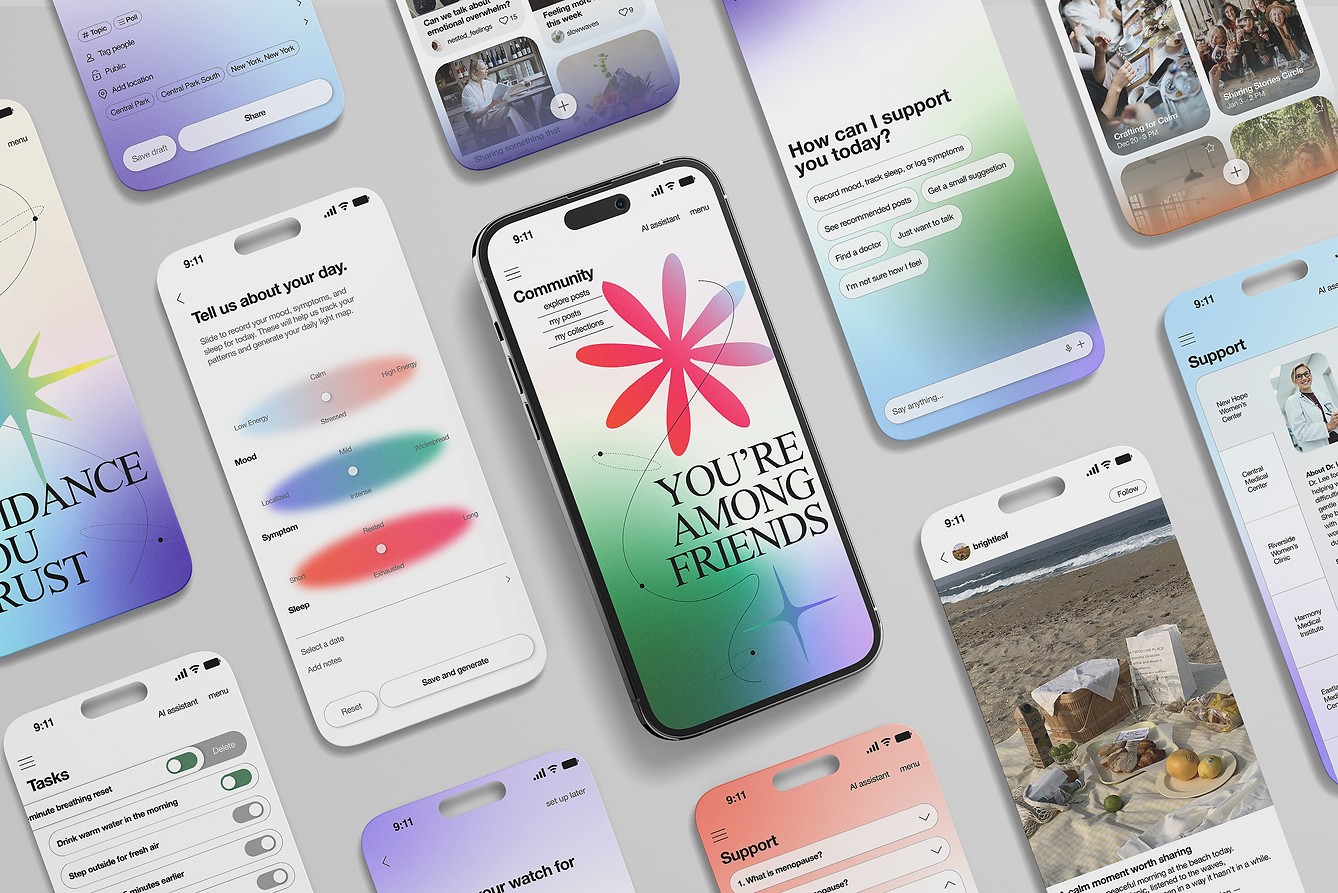
This project clarified for me that when design engages with the body, emotions, and long-term change, its value lies in building clear and credible boundaries between professionalism, emotional care, and everyday sustainability. In MENOIA, I treat design as a support structure that holds lived experience and helps users understand their state gradually, without adding pressure. Through the system design of logging, information presentation, visual tone, and interaction flow, the project translates fragmented feelings into reviewable patterns that can integrate into daily life.
It also reshaped how I see design’s role in social issues. When an experience is consistently overlooked, the priority is not making promises, but creating conditions for expression, shared clarity, and long-term dignity. As AI becomes increasingly embedded in everyday life, I hope to continue exploring how to build responsible support systems that balance empathy, boundaries, and sustainability, and form more credible connections between technology, culture, and individuals.
SOURCES(COMPILED & CITED)
(1) BRICS Women’s Development Report 2023
(2) Cigna 2023 Global Vitality Study 2023
(3) McKinsey analysis (drawing on IHME and WHO estimates)